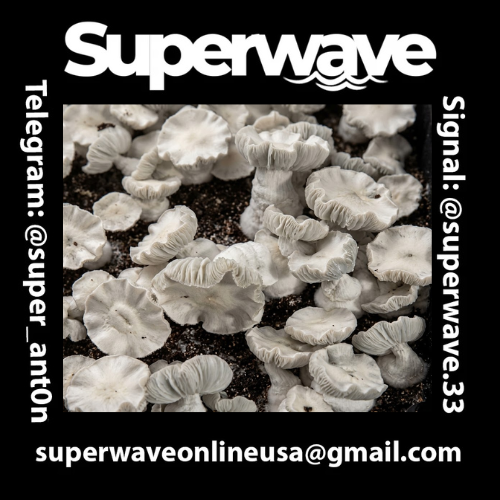

Please use only the official contact details below when reaching our support team.
Telegram account @Super_ant0n1 is NOT affiliated with us.
Our only official Telegram account is @Super_ant0n — without the “1” at the end.
For your security, always verify that you are communicating with one of the official accounts above before sending any payment. We cannot accept responsibility for payments sent to impersonators or unauthorized accounts.

Price range: $250.00 through $1,200.00
Jack Frost is an albino variety of Psilocybe cubensis with a rather unusual appearance. Most of the mushroom is white, from the stem right up to the cap. Then there are the gills. They start off pale but can turn blue-grey as the mushroom matures, sometimes becoming a much darker blue.
The caps are another giveaway. Instead of staying rounded, they often flatten and curl upwards as they develop. Not every specimen does this to the same degree. Some have only slightly raised edges, while others open so far that the underside becomes the most noticeable part of the mushroom.
It’s this combination of white tissue and blue gills that gave Jack Frost its name.
Unlike plenty of mushroom varieties with uncertain histories, Jack Frost has a known breeder.
Dave Wombat developed it by working with two existing cubensis lines: Wombat True Albino Teacher (TAT) and Albino Penis Envy (APE). The original project was called TAPE, a straightforward combination of the two parent names.
Wombat later described the breeding project on his own website. His early cultures produced mushrooms with different shapes and sizes, which left him unsure whether the cross had worked. The next generation provided stronger evidence. The mushrooms retained their pale colouring, and the blue gills became a much more consistent feature.
That’s when Jack Frost began to take shape as a recognisable variety.
There’s an interesting detail in Wombat’s account. Some of the earliest developing mushrooms had an orange tint before turning pale as they grew. Not exactly what you’d expect from a variety now known for being almost entirely white.
The name changed from TAPE to Jack Frost because of the mature mushrooms’ blue-and-white colouring. A much better fit, considering what they looked like.
The original breeder’s account is available at Wombat Labs.
A mature Jack Frost mushroom can look quite different from a young one.
Early on, the cap is usually rounded and the gills aren’t particularly visible. The white stem can be relatively thick, although the proportions differ between specimens.
As the cap opens, the edges may begin curling backwards. The gills become easier to see, and their colour can shift from white to pale blue-grey. In some mature mushrooms, the blue is much darker.
Wombat described this colour change as one of the most recognisable features of his original line.
Blue bruising is a separate but related characteristic. It can appear when mushroom tissue gets damaged, particularly around the stem.
The chemistry behind it has been studied. Researchers identified an enzyme-driven reaction involving psilocybin-derived compounds that produces the blue colouring seen in injured Psilocybe mushrooms.
A common assumption is that more blue means more psilocybin. It doesn’t work that neatly. Colour alone cannot establish the concentration of active compounds.
And although Jack Frost has a recognisable appearance, photographs aren’t enough to establish that an unidentified mushroom is genuinely Jack Frost, or even that it’s safe.
Jack Frost has developed a reputation for being stronger than an average cubensis mushroom. Its Albino Penis Envy ancestry is part of the reason for that reputation.
There is some laboratory evidence behind it, although the results need context.
In reporting published by DoubleBlind, laboratories described Jack Frost samples with psilocybin concentrations of roughly 7–12 milligrams per gram of dried material. Those figures describe the particular samples examined, not every mushroom sold under the Jack Frost name.
Different growers work with different genetic lines. Even mushrooms carrying the same variety name aren’t necessarily identical.
Research involving multiple Psilocybe cubensis strains has also shown substantial variation in their chemical profiles, including differences under controlled growing conditions.
Which leaves an obvious limitation. The name Jack Frost doesn’t tell anyone the exact strength of an individual mushroom. Neither does the colour of its gills, the size of its stem or how dramatically its cap has curled.
A batch-specific laboratory analysis is needed for a measured concentration.
Jack Frost contains psilocybin, a naturally occurring psychedelic compound. The body converts psilocybin into psilocin, which acts on serotonin receptors and produces changes in perception and consciousness.
People describe colours becoming more intense, ordinary patterns appearing to move, and time feeling unusually slow or fast. Mood and thought processes can change too.
Some experiences are described as pleasant or emotionally meaningful. Others involve fear, confusion, nausea or a sense of losing control.
These aren’t effects unique to Jack Frost. They’re associated with psilocybin more broadly, and there isn’t convincing clinical evidence showing that Jack Frost produces its own distinct, predictable type of experience.
The same person can also respond differently on separate occasions. Mental state, surroundings, health, other substances and the amount of psilocybin involved all matter.
Physical effects can include nausea, dizziness, headache and an increased heart rate. More serious psychological reactions are possible, especially for people vulnerable to psychosis or certain other psychiatric conditions.
Psilocybin is being investigated for possible therapeutic uses, but research conducted in supervised clinical settings shouldn’t be confused with the effects or safety of an untested mushroom product.
The family connection is clear, but the three names don’t describe identical mushrooms.
Albino Penis Envy is known for its pale appearance and relatively thick stems. True Albino Teacher belongs to the Golden Teacher family and is another pale cubensis line.
Jack Frost came from breeding those two varieties, although it developed a recognisable appearance of its own, particularly the blue gills and mature cap shape.
The parentage doesn’t mean Jack Frost inherited a fixed level of potency from either parent. Genetics influence mushroom chemistry, but they don’t provide a dependable measurement of a particular specimen’s psilocybin content.
Appearance is the easier distinction to describe. Strength requires actual evidence.
The blue gills are probably the feature people notice most in photographs of Jack Frost.
But there are two things worth separating. One is the blue-grey colouring that develops around the gills as the mushrooms mature. The other is the bruising that occurs after tissue damage.
Research on bruised psilocybin mushrooms has linked the latter to chemical reactions involving psilocin-derived compounds.
That explains the colour change without turning it into a strength test.
Dark blue bruising doesn’t establish a high psilocybin concentration. A mushroom with less visible bruising isn’t automatically weak either.
The colour is interesting, and in the case of Jack Frost, part of what makes the variety recognisable. It isn’t a substitute for identification or laboratory analysis.
Jack Frost was deliberately developed through breeding rather than discovered as a named variety growing in the wild.
Its species, Psilocybe cubensis, occurs naturally in suitable environments in different parts of the world. Jack Frost, however, refers to a cultivated genetic line within that species.
That distinction matters. A wild mushroom that happens to have white tissue or blue bruising isn’t automatically Jack Frost.
Several mushrooms can share similar physical features, including some that are poisonous. Identification based on a photograph or a common name alone is unreliable.
Jack Frost has an unusually well-documented origin for a modern cubensis variety. Its original breeder has described the parent lines, the early development and how the name came about.
Its appearance is also reasonably well established. Pale fruiting bodies, caps that often turn upwards and gills that can become blue as they mature.
Potency is where the certainty ends. Published testing gives some useful examples, but no strain description can guarantee the chemical content of an individual mushroom.
There is also no solid basis for promising Jack Frost-specific psychological effects. The compounds involved are known, and their risks have been studied, but individual experiences remain unpredictable.
For identification, physical features and breeding history are useful starting points. For chemical strength, independent testing is what matters.
| Gram | 28, 56, 112, 224 |
|---|



Reviews
There are no reviews yet.